


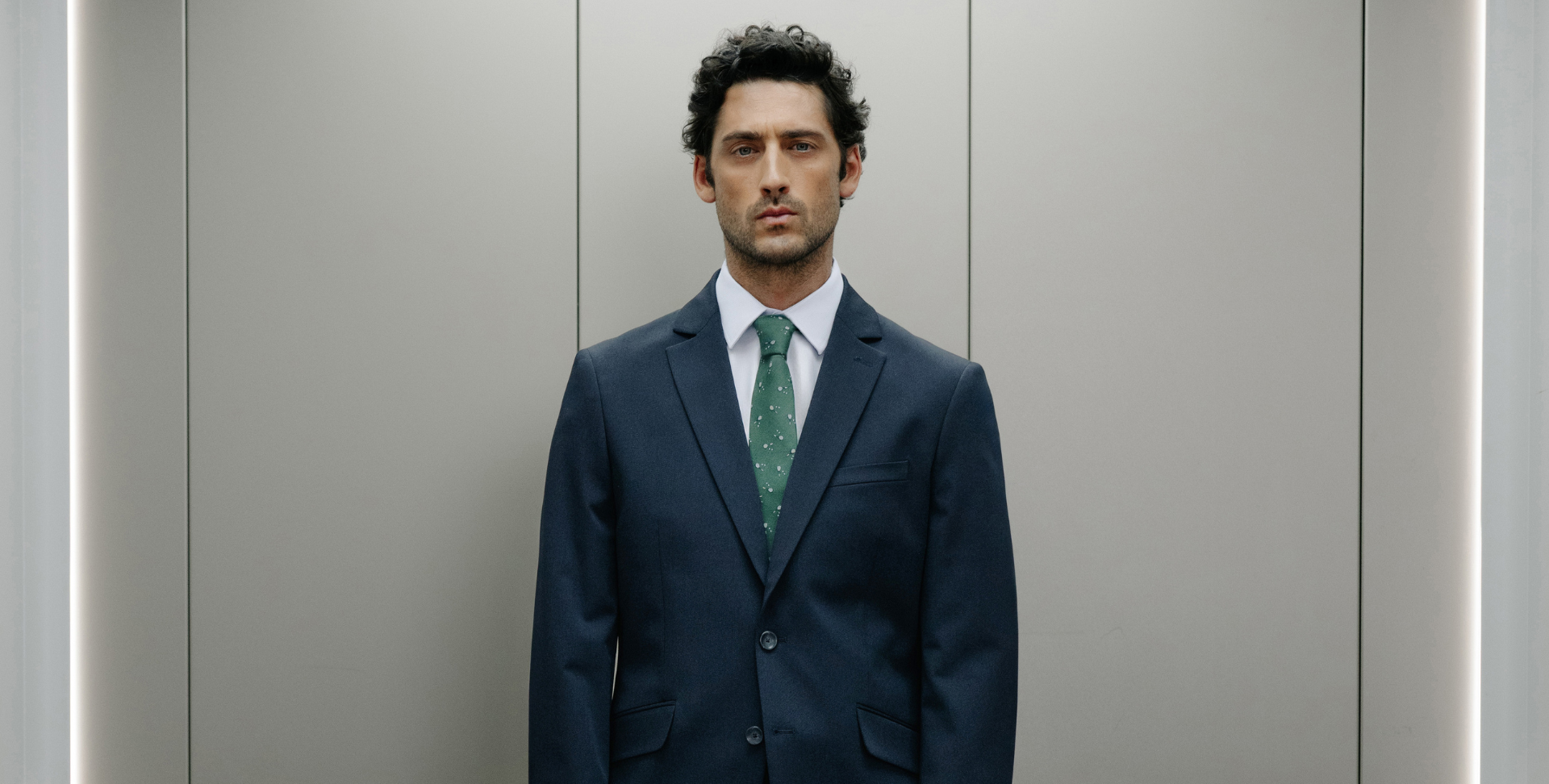
When I wear a well-tailored suit, I feel the whole outfit come alive: the jacket fits snugly around my torso, the shoulders rest comfortably, and the trousers drape gracefully. This "glove-like" fit isn't accidental, but the result of years of tailoring experience. At Boston Brand, we've seen how a poorly chosen suit can ruin a first impression, while a perfectly tailored one projects authority, confidence, and style.
You will learn to distinguish the cuts (slim fit, regular fit and comfort fit), to check the fit of the jacket and trousers , to take your measurements accurately and to use equivalence charts.

Choose your ideal cut
The first decision—and perhaps the most crucial—is finding the right cut. “Step 1: Find the right cut. Whether you buy a suit in a physical store or online, you should know that when choosing a suit size, the correct fit is everything.” This statement, taken from our daily practice at Boston Brand, summarizes the importance of choosing a cut based on your body type and style.
Slim Fit and Extra Slim Fit
Slim fit and its even more fitted version, extra slim fit , are characterized by very close, sporty lines. Personally, I find that a slim fit suit enhances my figure when I'm going for a modern look: the blazer hugs my torso and chest without any looseness, and the trousers follow the line of the leg with a slight flare.
● Advantages : stylized effect, feeling of vigor and athletic shape.
● For whom : slim or athletic bodies that want a contemporary look.
● Caution : Check that the fabric allows for minimal movement, especially when sitting down.
Regular Fit
The regular fit is a timeless classic. At Boston Brand, we recommend this cut to men of average or slightly athletic build who are looking for versatility. “They feature a slight taper at the waist and are a timeless classic that is both elegant and comfortable.” When I tried them on, I noticed a natural drape: neither too tight nor too loose.
● Advantages : perfect compromise between formality and comfort.
● For whom : most male silhouettes.
● Caution : Check that the flap covers the chest well without being too tight.
Comfort Fit
For those who prioritize total comfort and freedom of movement, there's the comfort fit , or relaxed cut. "Thanks to its longer jacket, wider shoulders, and looser waist, it provides greater freedom of movement." I usually suggest it to those who work on their feet all day or travel a lot, as the wider trousers and looser jacket prevent pinching and annoying wrinkles.
● Advantages : maximum mobility and prolonged comfort.
● For whom : robust bodies or those who want a relaxed look without sacrificing elegance.
● Caution : Do not confuse this with being oversized; continue to apply the shoulder and chest tests that we will see later.
The perfect American-style suit: fitting tips
A poorly fitting blazer ruins the whole outfit, so I'll detail how to check the chest, shoulders, sleeves, and length . At Boston Brand, we use four quick tests based on our experience:
1. Chest area
In a well-fitting blazer, the lapels lie flat without tension. “You’ll know the blazer is too tight when the lapels gape open at the sides, and it’s too loose when there’s too much space in the front.” I always recommend the two-finger test: with the blazer buttoned up, place two fingers between it and your shirt, just above the buttons. If they fit comfortably, the chest size is correct.

2. Shoulder width
The shoulder seam should visually break up your natural line. “Stand sideways next to a wall. If the shoulder touches the wall, but the rest of the sleeve doesn’t, the suit is too big.” In my experience, this test is foolproof: a loose shoulder creates creases, and a tight one causes wrinkles at the top.
3. Sleeve Length
The ideal sleeve length shows approximately 1 cm of the shirt cuff. If the sleeves completely cover the cufflinks or are too short, it immediately looks careless. When I try on a blazer, I move my arm to ensure the shirt cuff remains visible when I bend my elbow.
4. Length of the blazer
While it's a matter of personal preference, it should always at least cover your rear. "With your hands at your sides, try to slip your fingers under the hem of the jacket. If you can't reach the seam, the jacket is too long; if it ends at your wrist, it's too short." I use this check daily to ensure a balance between coverage and proportion.
Boston Brand tip: Write down your chest, shoulder, and sleeve measurements in a notebook; that way, every time you compare models, you'll have everything at hand.
The pants that adapt to you
A perfectly tailored blazer isn't enough: the trousers must fit just as well. At Boston Brand, we distinguish two main styles:
Soft break (classic)
With a classic slim-fit suit, the trouser hem reaches just to the top of the shoe, creating a slight crease ("soft break") in the leg. I always recommend this option in formal settings: it provides a clean, streamlined look and avoids unsightly wrinkles.
● Advantage : traditional and elegant look.
● Check : When standing, the crease should be discreet and uniform.
Without break (ankle-shaped)
For a modern, sportier look, ankle-length trousers that show off part of the sock are preferable. “Try ankle-length trousers that reveal bold patterned socks, or for warmer temperatures, opt for short socks.” Personally, I prefer this cut for informal events: it adds a creative touch without sacrificing style.
● Advantage : freshness and versatility.
● Check : Sit down and observe that the pants do not go up past your calf; if they do, they are too short.

Waist and overall fit
The measuring tape should sit just below the navel . Pants that feel tight when you sit down or leave a vertical crease in the crotch indicate the wrong size. At Boston Brand, we always ask our customers to sit down and walk around a few times: a small gesture that reveals a lot about true comfort.
How to take your measurements step by step
For millimeter precision, follow this procedure with a measuring tape and, if possible, with the help of a second person:
- Chest : Measure around the widest part, just below the armpits and above the shoulder blades. Keep your arms relaxed.
- Height : barefoot, standing on a flat surface. Ask someone to measure from the crown of your head to the floor, with your back straight.
- Blazer length : from the highest point of the shoulder to wherever you want it to reach (usually covering the buttocks).
- Sleeve length : Measure from the center of the nape of the neck, over the shoulder to the wrist; the curve over the elbow is measured on the outside.
- Waist : right at the navel, without tightening the tape.
- Hips : around the widest part of the buttocks, with feet together.
- Inside leg : from the crotch to where you want the hem.
- Outer leg : from the waist to the hem, following the side line of the pants.

“Many online stores offer tools to calculate men’s suit size based solely on height, weight, waist, and chest. However, to be sure, it’s best to check your exact measurements using a men’s suit size chart.” This recommendation, straight from our protocols, has prevented returns and excessive alterations in more than 80% of cases.
Choosing the perfect men's suit size isn't a matter of luck, but of method. From selecting the cut to checking the break , taking precise measurements , and using size charts correctly, every step ensures comfort and lasting style.
At Boston Brand, we've seen how a well-fitting suit boosts the wearer's confidence. Use the two-finger test, the wall test for shoulders, and make sure the jacket covers your rear and allows about a centimeter of shirt cuff to show. For the trousers, decide if you prefer a classic soft break or a modern look without a break, and always measure the waist, inseam, and outseam.
